Intro
The climate crisis is driving a rapid destabilization of mountain environments, illustrated by the increasing occurrence of rock instabilities, the degradation of high-altitude infrastructure, and the growing challenges to certain human activities.
A key process behind these transformations is the warming and degradation of mountain permafrost—a heterogeneous material in which ice plays a fundamental mechanical role in the cohesion of rocks and soils. Rising temperatures and repeated freeze–thaw cycles induce complex processes of fracturing, loss of cohesion, and water percolation, affecting both natural rock slopes and engineered structures.
Our understanding of these mechanisms remains limited due to the multiphase and multiphysical nature of frozen materials.
In this context, cold laboratory facilities represent an essential tool to experimentally reproduce, observe, and quantify the thermo-mechanical processes involved, bridging field observations and numerical modelling, with the ultimate goal of improving hazard forecasting and supporting the adaptation of mountain infrastructure.
Uniaxial Testing Press (500 bars)
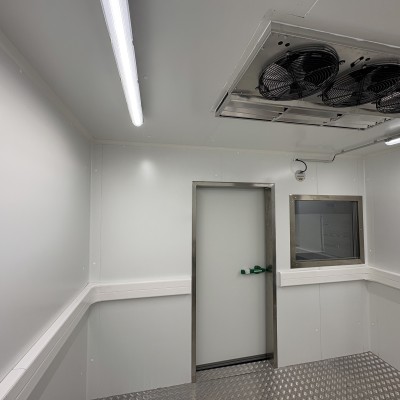
The cold room facility at ISTerre (Le Bourget-du-Lac) will soon be equipped with a new instrumented uniaxial testing press, developed in collaboration with Top Industrie. This system will enable mechanical testing under controlled loading directly at sub-zero temperatures.
Integrated within the cold room environment, the press will allow detailed investigation of the mechanical behaviour of soils, rocks, frozen materials, and cementitious geomaterials under realistic cold-climate conditions. It will support experiments involving temperature control and freeze–thaw cycles, making it possible to quantify the effects of temperature on strength, deformation, and damage processes.
Velocity range: from 1,17×10??m/s to 3,51×10??m/s (maxi)
Measurements of force, pressure, stress/strain, temperature (6 thermocouples) and soon of acoustic emissions
A cold room dedicated to rock mechanics!
At ISTerre, many research on the physical behaviour of geomaterials under cold conditions often requires controlled low-temperature experimentation. To support this work, a specialised cold room that enables experiments at sub-zero and very low temperatures has been installed.
Such cold rooms create stable environments where the temperature can be precisely regulated, allowing to simulate freezing conditions similar to those found in periglacial and high-mountain environments. This facility, unique in France, is essential for studying processes such as freeze-thaw cycles, the mechanical behaviour of soils and rocks at low temperatures, and the degradation of frozen geomaterials under climatic forcing—a topic of growing importance in the context of climate change. This national facility offers a controlled temperature range from about 0°C down to -25 °C.